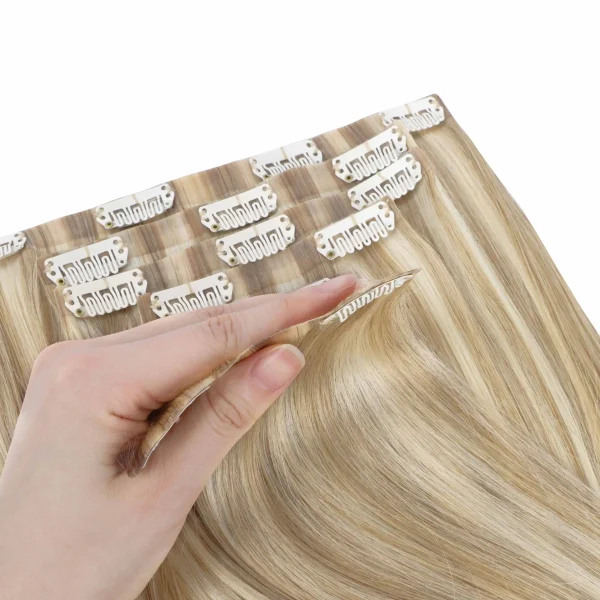


Types of Hair Extensions: A Complete Guide for Beginners
Clip-ins, halos, tape ins, keratin bonds and more: how every type of hair extension works, how long it lasts and...
read more

Hair extensions can look like magic in photos: short hair suddenly falls past the shoulders, thin ponytails become thick and glossy, and a fringe appears without a single cut. But how do hair extensions actually work, and what happens to your own hair while you wear them?
This guide explains what hair extensions are made of, how they attach, how they blend with your hair and what you should know before buying your first set. If you are completely new, it is a good companion to our guide to the types of hair extensions.
Hair extensions are pieces of real human hair or synthetic fibre that are added to your own hair to change its length, volume, colour or style. They are attached close to the scalp and hidden under your natural hair, so that both fall together and look like one head of hair.
Every extension has two parts:
The base decides how the extension attaches and how long it stays in. The hair decides how natural it looks, how you can style it and how long it lasts.

There are only a few ways to attach extra hair to your own, and every product on the market uses one of them.
Small snap clips with tiny rubber grips are sewn onto a weft. You open the clip, slide it into a thin section of your hair close to the root and snap it shut. The grips hold the hair without pulling it. Clips are used in clip-in hair extensions, clip-in bangs and toppers.
Halo extensions use a thin, clear wire shaped to sit around your crown. The weight of the hair rests on the wire, and your own hair is pulled over the top to hide it. Nothing touches your roots at all. Learn more in our halo hair extensions guide.
Ponytail extensions attach around a ponytail or bun you have already made. A drawstring tightens around the bun, a wrap strip hides a clip at the base, and a claw clip grips the ponytail directly.
Salon methods bond the extension directly to your hair. Tape ins use adhesive strips, keratin bonds use melted or cold fused keratin tips, and micro rings clamp small sections of hair inside tiny metal rings. These stay in for weeks and are fitted and removed by a stylist. We compare them in detail in salon extensions vs clip-ins.
Braiding hair is woven into your own hair as you braid, while crochet hair is looped onto cornrows with a needle. Sew in wefts are stitched onto tight cornrows.
A good blend is what makes extensions invisible. It depends on four things working together.
Human hair extensions are made from real hair that has been collected, sorted and sometimes coloured. Remy hair keeps all the cuticles facing the same way, which keeps it smooth and reduces tangling. Raw hair is unprocessed and keeps its natural colour. Human hair can be washed, curled and straightened just like your own. See our guide to Remy, virgin and raw hair for the full picture.
Synthetic extensions are made from heat resistant fibres designed to look like hair. They come pre styled, keep their curl or wave in humidity and cost less. Most cannot take high heat, and they wear out faster with daily use.
If you are deciding between the two, read our full human hair vs synthetic hair extensions comparison.
This is the question most people ask before trying extensions, and the honest answer depends on the method and how you wear it.
We cover the risks and how to avoid them in do hair extensions damage your hair.
Temporary extensions stay in for as long as you choose to wear them in a day, then come out. Salon methods stay in continuously: tape ins for around 6 to 8 weeks per fitting, keratin bonds for around 3 to 4 months and micro rings for around 2 to 3 months before they need moving up.
The hair itself is a separate question. With good care, human hair extensions can be worn for many months, while synthetic pieces usually last a few months of regular wear. Our guide on how long hair extensions last breaks this down by type.
A lot of what people believe about extensions comes from bad experiences with poor quality hair or badly fitted salon methods. Here are the myths we hear most often.
Extensions look fake when the shade, texture or length does not match, or when the base sits too close to the parting. When those four things are right, nobody can tell. Most of the obvious extensions you notice are simply the wrong colour or far too long for the wearer’s own hair.
Extensions are often most useful for medium or shoulder length hair, because they create the biggest change. As long as your hair can cover the base, you can wear them.
Temporary extensions that are lightweight and removed at night do not cause hair loss. Problems come from constant tension, very heavy sets on fine hair and salon extensions that are left in far too long. Sensible weight and good habits keep your own hair healthy.
Salon methods need a stylist, but clip-ins, halos, ponytails and bangs are made to be worn at home. Most women learn to put in a full clip-in set in under fifteen minutes after a couple of tries.
Modern heat resistant synthetic fibres look soft and natural, especially in pre styled waves and curls. They are not as long lasting or versatile as human hair, but they are a great choice for occasional wear and trying a new look.
If you are buying hair extensions for the first time, keep it simple:
Not sure where to start? Our step by step guide to putting in clip-in hair extensions shows how easy it is, and you can always send us a photo on WhatsApp for shade advice.
Not when the shade, texture and length match and the base is placed below your parting. Most people only notice that your hair looks fuller.
A well chosen set feels light after a few minutes. If extensions feel heavy or pull, the set is too thick for your hair or the clips are on sections that are too small.
With temporary extensions, take them out first and wash your hair and the extensions separately. Salon extensions are washed in place with gentle, sulphate free products.
Yes, as long as your hair is long enough to cover the base, usually around chin length or longer. See our guide to hair extensions for short hair.
Not for temporary styles. Clip-ins, halos, ponytails and bangs are designed to be worn at home. A stylist can help with a first trim to blend layers, but it is optional.
Now that you know how hair extensions work, browse our full hair extensions collection or start with an easy halo. Every order comes with Cash on Delivery and free UAE delivery on orders over AED 200.